
February 9, 2026
Marketing performance optimization is the systematic process of using data, testing, and strategic adjustments to improve marketing results and maximize return on investment. It transforms marketing from a guessing game into a measurable growth engine.
Quick Answer: What Marketing Performance Optimization Includes
Every year, Spotify Wrapped reminds marketers of an uncomfortable truth: AI isn't just supporting marketing anymore—it's often the star of the show. Yet most marketing teams still operate like it's 2019. They launch campaigns, wait weeks for results, and make decisions based on gut feeling instead of hard data.
The numbers tell a different story. 65% of marketers are meeting or exceeding their performance benchmarks, according to recent research. But what separates them from the other 35%? It's not bigger budgets. It's systems.
The best performers don't just run campaigns. They build optimization loops. They test constantly. They measure what matters. They use AI to find patterns humans miss. And they align every dollar spent to a business outcome, not a vanity metric.
This matters more now than ever. Ad costs keep rising. Privacy regulations keep tightening. Algorithm changes keep disrupting what worked last quarter. The old playbook of "set it and forget it" marketing is dead.
Marketing performance optimization is how you survive this environment. It's the difference between a marketing budget that bleeds money and one that predictably generates revenue.
Most teams struggle with three core problems:
These aren't small problems. They're the reason 33% of marketers cite measuring marketing ROI as their biggest roadblock. They're why 29.6% struggle with generating quality leads. And they're why so many marketing departments can't prove their value when budget season arrives.
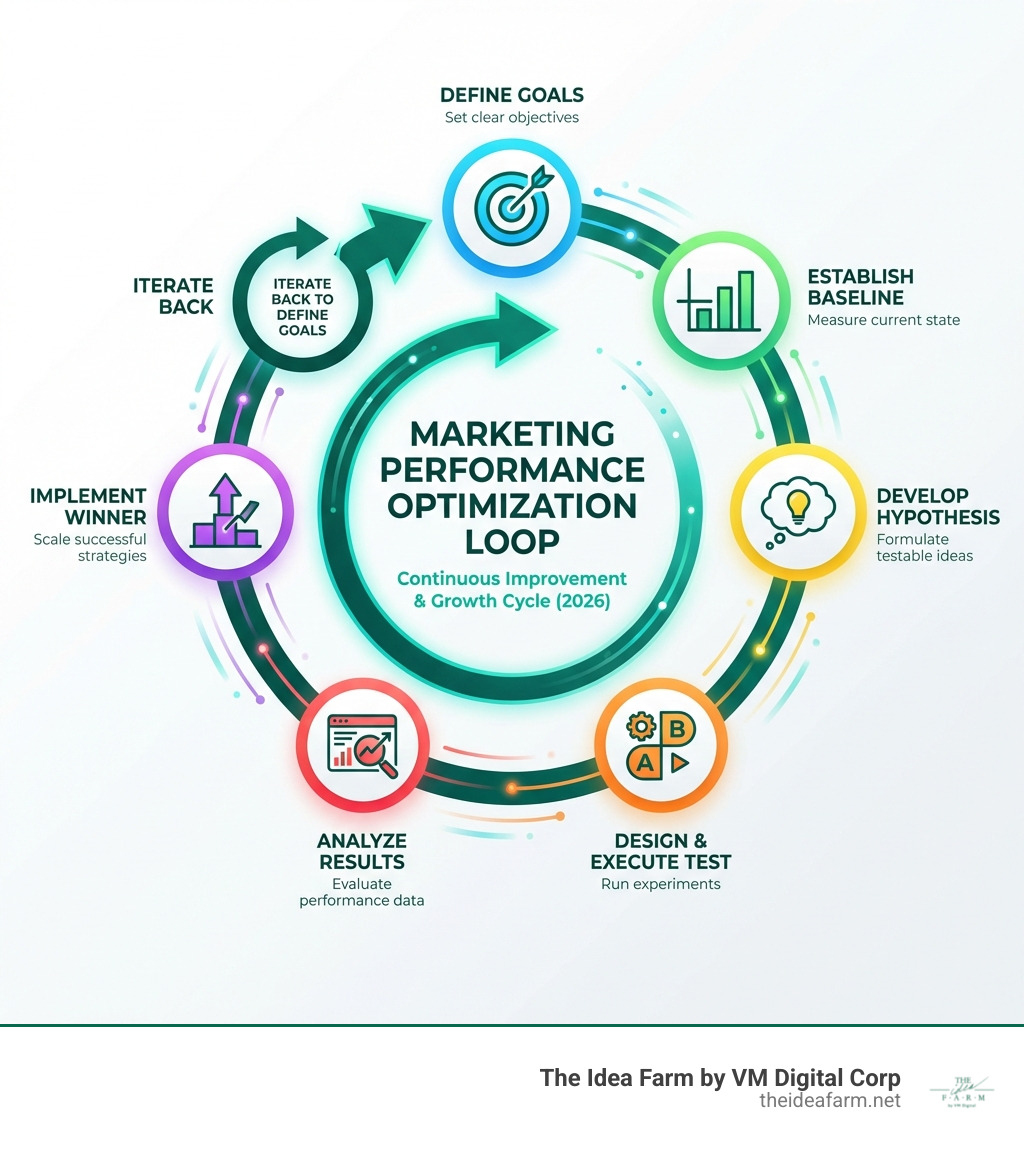
But here's the good news: optimization isn't complicated once you understand the system. It's a repeatable process. Define what success looks like. Measure where you are now. Form a hypothesis about what could work better. Test it. Analyze the results. Keep what works. Kill what doesn't. Repeat.
The companies that master this loop don't just survive. They grow 70% faster than their peers, according to research on leading marketers. They turn marketing from a cost center into a revenue engine.
This guide will show you how to build that engine. We'll cover the core pillars of modern optimization, from AI-driven targeting to creative testing systems. We'll explain which metrics actually matter and how to measure them. We'll show you how to optimize across channels, from SEO to paid social to retail media. And we'll give you a step-by-step framework you can implement immediately.
I'm Jose Escalera, CEO of The Idea Farm, and I've spent my career building companies and marketing systems that connect strategy to measurable results. Marketing performance optimization isn't just theory for me—it's how we help clients turn wasted spend into predictable growth.
At its heart, marketing performance optimization is about making your money work harder. Think of it like tuning a car engine. You can have a fast car. But if the engine is not tuned, you waste gas. In marketing, gas is your budget. If you do not tune your campaigns, you waste money.
In cities like Houston, TX and Danville, KY, businesses face a lot of competition. You cannot afford to guess where your leads come from. You need to know. Today, the world moves fast. People see thousands of ads every day. To win, your ads must be better, faster, and smarter.
Optimization helps you reach your business goals. It helps you grow your revenue. It makes your team more efficient. When you optimize, you stop doing things that fail. You do more of what works. This leads to a steady growth chart.
Research shows that using AI can help a lot. For example, Euroflorist used AI to test their website. They saw their conversion rates go up by 4.3%. That might sound small. But for a big company, that is millions of dollars in new sales.
For a long time, marketers looked at "vanity metrics." These are things like likes, follows, and page views. They make you feel good. But they do not pay the bills.
Modern marketing performance optimization focuses on value. We look at lead quality. We look at Marketing Qualified Leads (MQLs). We ask if the sales team is happy with the leads we send them.
About 39.4% of marketers now say lead quality is their top goal. They want leads that actually turn into customers. This requires sales and marketing to work together. If they do not talk, money is wasted. We build systems that link these two teams. This ensures every lead has a clear path to a sale.
The old way was to "set it and forget it." You would launch a campaign and let it run for months. That does not work anymore. Why? Because the world changes every day.
First, search engines change their rules. Google updates its algorithm often. Now, AI search is changing things again. About 40.6% of marketers are updating their SEO plans right now to keep up.
Second, privacy laws are getting stricter. Cookies are going away. You cannot track people the way you used to. You need new ways to find your audience.
Third, data happens in real-time. If an ad stops working on Monday, you should not wait until next month to fix it. Leading teams check their data every day or every week. They make changes fast. If you stay static, you fall behind.
To build a great system, you need strong pillars. We focus on three main areas. These help you scale your growth without losing control.
| Feature | Manual Optimization | AI-Driven Optimization |
|---|---|---|
| Speed | Days or Weeks | Real-time or Minutes |
| Scalability | Low (Limited by human time) | High (Can handle millions of ads) |
| Accuracy | Prone to human error | Data-backed and precise |
| Testing | One or two tests at a time | Hundreds of tests at once |
AI is the biggest change in marketing history. It is like having a thousand tiny employees working for you. These employees never sleep. They look at your data 24 hours a day.
Machine learning helps us predict the future. It can tell us which leads are most likely to buy. It can also tell us when someone is about to stop being a customer. This lets us act before it is too late.
Automated bidding is another big win. In the past, a person had to change how much you paid for an ad. Now, AI does it in a split second. It adjusts your bid to get you the best price for a click or a sale. About 67.4% of marketing teams already use AI to optimize their campaigns.
Your message is your most important tool. If your ad is boring, no one will click. Even the best AI cannot save a bad ad. That is why we build a creative testing engine.
We test three main things:
A Forrester survey found that 2 out of 3 marketing leaders think AI creative testing improves quality. It helps you see what people actually like. Instead of guessing, you use science. This makes your ads much more powerful.
You cannot improve what you do not measure. But many businesses track the wrong things. They look at "vanity metrics" instead of "growth metrics." To fix this, you need a solid data foundation.
The most important metrics are:
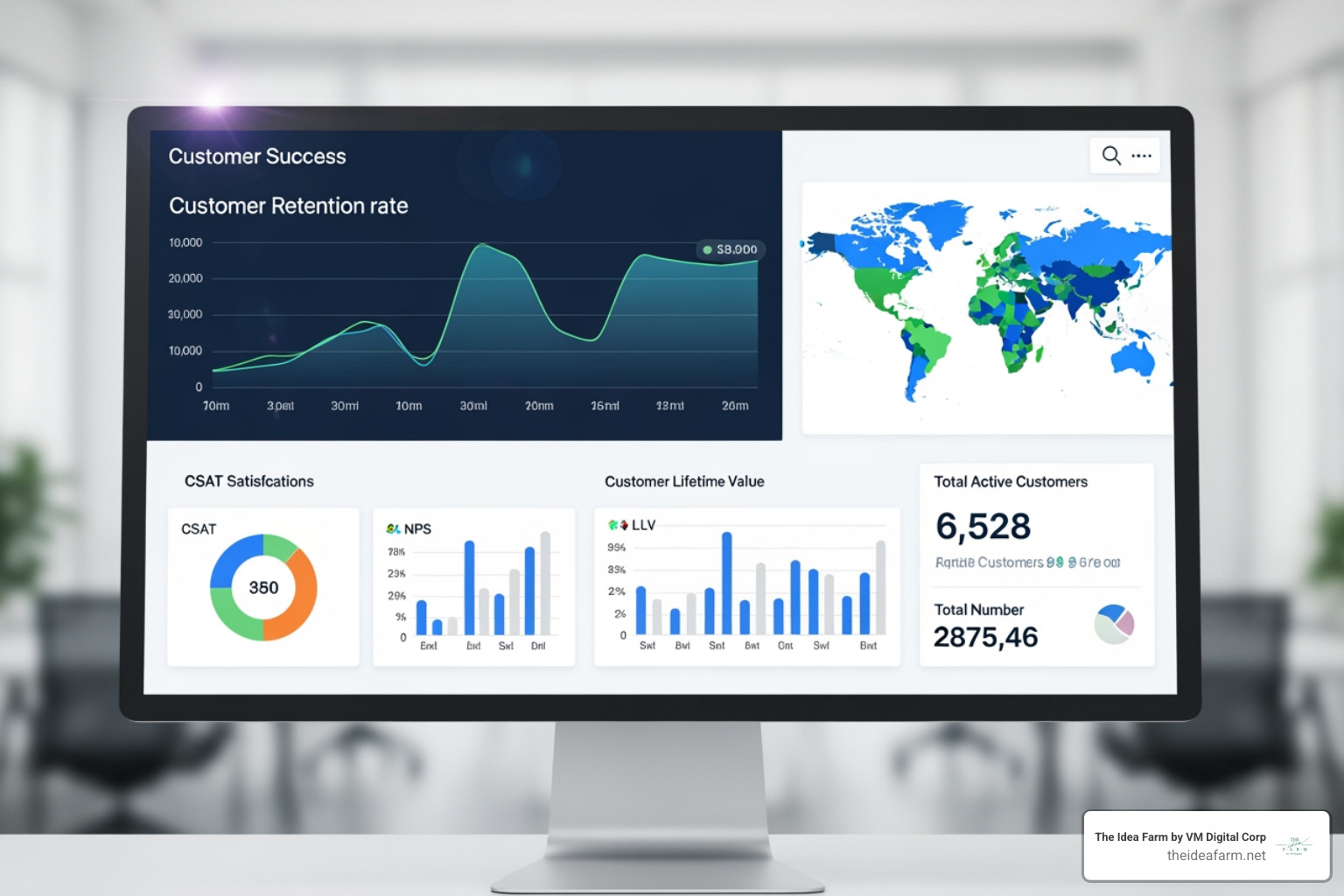
At The Idea Farm, we help you see all this in one place. You can see more info about the growth dashboard on our site. It connects your ads, your website, and your sales data. This gives you a "single source of truth."
Attribution is a fancy word. It just means "figuring out what made the customer buy." Most journeys are not simple. A customer might see a Facebook ad. Then they search on Google. Then they read a blog post. Finally, they buy.
Which one gets the credit?
About 46% of top marketers use all three of these. They use MMM for the big plan and MTA for the daily work. This gives them the best results.
Data silos are the enemy of growth. A silo is when your Facebook data is in one place and your sales data is in another. They do not talk to each other. This makes it hard to see the truth.
We help businesses build unified systems. This means all your data flows into one central hub. We also set up "governance." These are rules for how data is handled. It makes sure your data is clean and correct.
Your website is often the center of this hub. You can find more info about website systems to see how we build sites that track everything perfectly. When your data is unified, you can make decisions in minutes, not days.
Your customers are everywhere. They are on Google. They are on Instagram. They are watching TV. To win, you must be everywhere too. But you must be smart about it.
This is called an "omnichannel" approach. It means your message stays the same across all platforms. Research shows that customers who use four or more channels spend 9% more money. They are your best customers.
Many marketers spend all their money getting people to their website. Then, they forget to fix the website itself. If your website is hard to use, people will leave. This is a waste of money.
We look for "friction." Friction is anything that slows a customer down.
Baymard research shows that 18% of people leave because the checkout is too long. By making your forms shorter, you can get more sales without spending a penny more on ads.
Two big trends are changing marketing right now.
These channels are great because they provide "closed-loop" data. You can see exactly who saw an ad and then bought the product. You can learn more info about digital ads and how we use these new tools to drive growth.
The future of marketing performance optimization is exciting. We are moving beyond just clicks. We are looking at "attention."
Not all views are equal. Some people look at an ad for one second. Others look for ten seconds. Attention metrics measure how much people actually care.
Research on attention shows that ads with high attention have 41% higher brand lift. They also have 55% more impact on sales. In the future, we will pay for attention, not just impressions.
Other trends include:
Some people think you have to choose between "Brand" and "Performance." Brand is about being known. Performance is about getting a sale right now.
But you need both. Brand building creates "mental availability." It makes people think of you first. Performance marketing captures that demand and turns it into cash. They work together like a team. Leading marketers spend about half their budget on each.
As cookies go away, we need new ways to track data. "Clean rooms" are one solution. They let companies share data safely without breaking privacy laws.
We also use "server-side tracking." This is a way to track sales that does not rely on the user's browser. It is more accurate and better for privacy. These tools help us solve the data problem. They ensure we always have the numbers we need to grow.
Starting is simple but requires a plan. First, set clear goals. Know what you want to achieve. Second, find your baseline. How are you doing right now? Third, make a guess (a hypothesis) about what could be better. Fourth, run a test. Fifth, look at the results and repeat. This loop is how you win.
Brand marketing is about awareness. It is a long-term play. You want people to remember your name. Performance marketing is about action. You want them to click or buy right now. Brand is like planting a tree. Performance is like picking the fruit. You need to do both to have a healthy garden.
You should monitor your ads every day to catch big problems. You should make small adjustments every week. Every month, you should have a big meeting to look at the strategy. This ensures you are always moving in the right direction.
Marketing has changed. You can no longer rely on luck or big budgets. You need a system. You need marketing performance optimization.
At The Idea Farm, we do not just give advice. We are your Fractional Growth Partner. We build the systems that make your business grow. We connect your data. We test your creative. We optimize your budget.
Whether you are in Houston, TX or Danville, KY, we can help you turn your marketing into a predictable revenue engine. We focus on the numbers that matter to your business. We help you scale in a way that is sustainable and profitable.
If you are ready to stop wasting money and start seeing real results, we are here for you. You can find more info about fractional CMO services on our website. Let's build something great together.